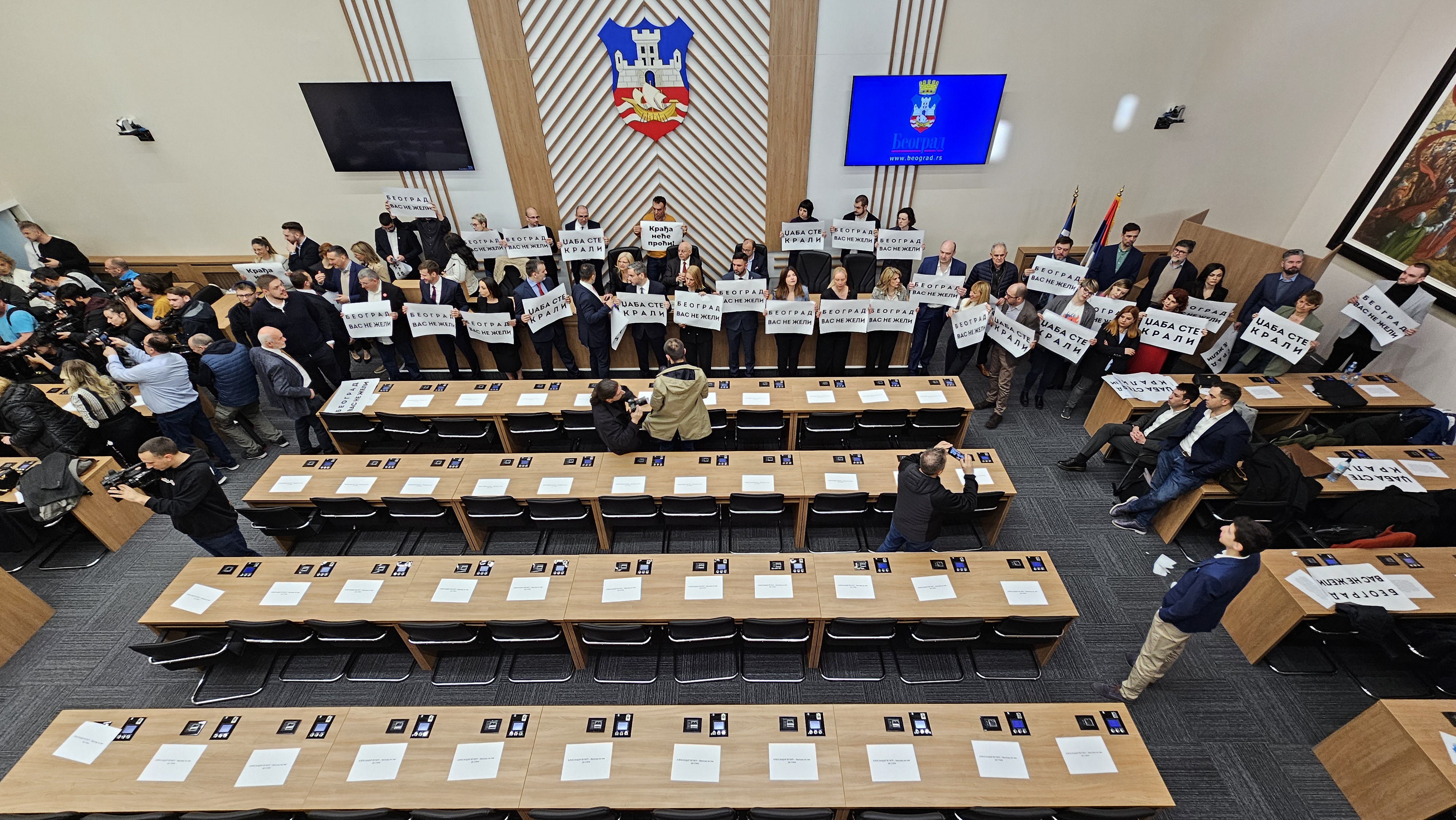
Opposition holding signs accusing ruling parties of election fraud in the City Assembly lacking a quorum, 1 March 2024
Photo: FoNet
BELGRADE – Even though they had previously announced that they would decide whether to form a majority in Belgrade or go for a new election by 1 March, Serbian Progressive Party (SNS) decided on Friday to postpone the decision for another two days, until the legal deadline.
Just like on 19 February, SNS and their coalition partner Socialist Party of Serbia (SPS) denied the quorum today by not showing up to the first session of the Belgrade Assembly, together with some councillors from the list “WE – The Voice from the People”.
This means that the leadership of the new City Assembly, including its president (speaker), has not been elected. This step is need for the Assembly to be constituted.
If the Assembly is not constituted by 3 March, two months after the publication of the final results, a new election is automatically triggered. The president of the National Assembly has to call it within 30 days, which starts the campaign that lasts from 45 to 60 days.
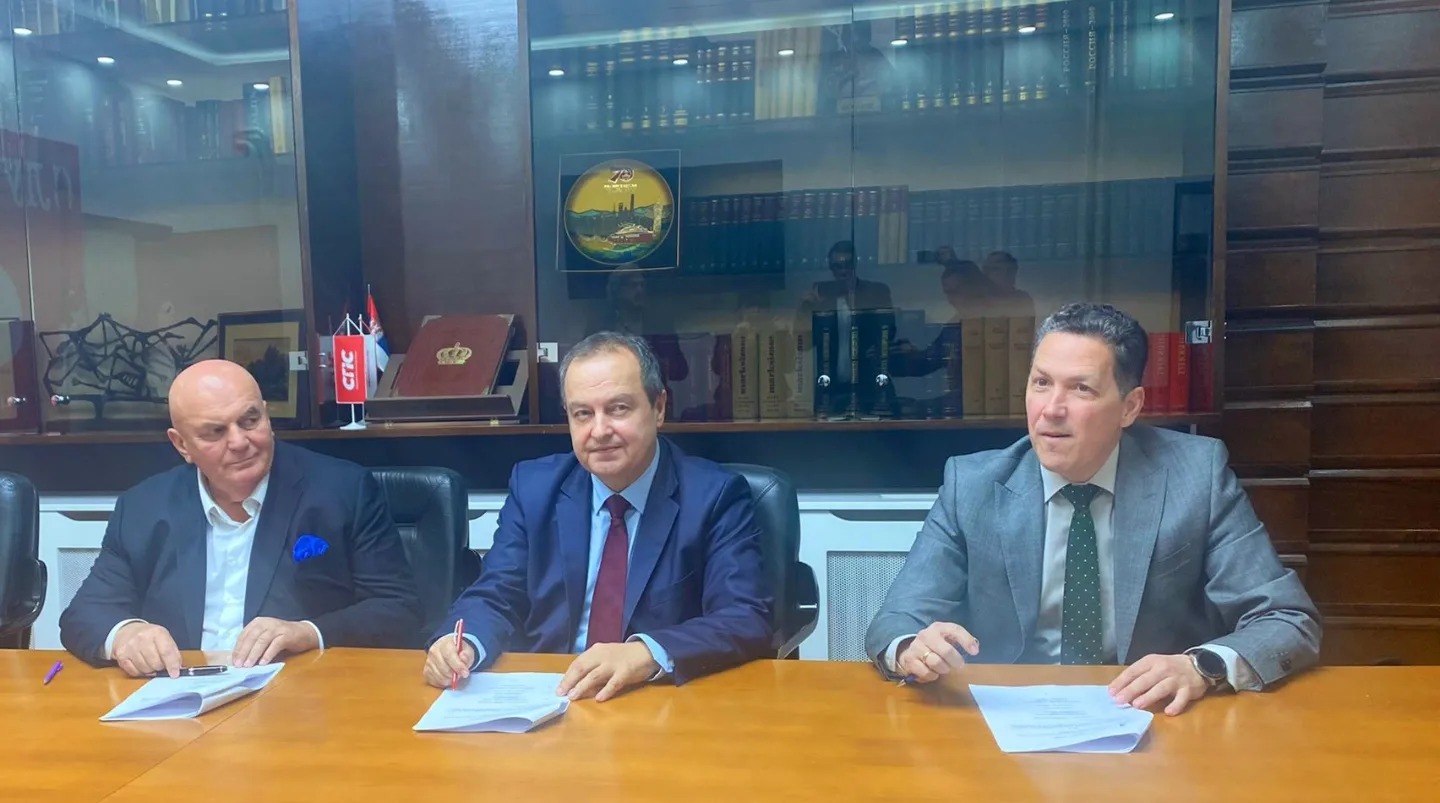
“We will reach a joint position in the coming two days and carefully think about what we are going to do”, said Aleksandar Šapić, SNS mayoral candidate, in today’s press conference.

Aleksandar Šapić holding a press conference, 1 March 2024
Photo: FoNet
This means that the earliest possible date of a new Belgrade election could be 21 April 2024 (elections in Serbia are usually held on Sunday), while the latest possible date could be the last weekend of May or the first weekend of June.
This would also mean that the new election in Belgrade would not coincide with the regular local elections in the rest of the country’s major cities, such as Novi Sad and Niš, which can only be called after 7 June. Snap elections, on the other hand, could be triggered earlier by mayors resigning from their offices, just like in the case of partial local elections of December 2023.
There is another possibility to trigger new election in Belgrade. The City Assembly can be constituted by 3 March, but fail to elect a new mayor after another 30 days. Early election is then also called by the president of the National Assembly. In this case, it could coincide with the regular local elections in the rest of the country.
Twists and turns in the formation of a majority in Belgrade
Election in Belgrade held on 17 December returned a hung local parliament, with neither list winning an overall majority of 56 seats. The previous ruling coalition, SNS-SPS, won 54 seats, while the opposition “Serbia against Violence” and NADA coalitions won 50 seats. The remaining 6 seats were won by the list “WE – The Voice from the People”, whose most prominent member is a controversial pulmonologist Branimir Nestorović.

The election was marred by allegations of serious irregularities, including organised voter migrations. SNS was accused of registering voters who otherwise do not live in Belgrade and then transporting them to vote on election day.
In its final report on Serbian elections, OSCE/ODIHR international mission mentioned these allegations, assessing that the responsible institutions did not react to them adequately. Opposition lists “Serbia against Violence” and NADA rejected the result of the election as fraudulent and a series of protests was held in December and January.
Despite these accusations, speculations were immediately made in public that SNS would form yet another city administration with SPS and secure the support of two necessary councillors from other lists. In a December press conference, Branimir Nestorović alleged that several unnamed people from his list were approached and offered “six-figure sums” to support SNS in Belgrade. He said he would not support either side and that he supported the scenario of a new election.
Leading up to the first session of the Belgrade assembly on 19 February, SNS claimed it has the necessary majority of at least 56. Its representatives confirmed that two councillors of Nestorović’s list were ready to support them.
However, since 18 February, SNS leadership – President of Serbia Aleksandar Vučić, President of SNS Miloš Vučević and candidate for the mayor Aleksandar Šapić – have stated on multiple occasions that, while they do have the necessary majority, they wanted the support of Nestorović himself, so that the new majority is “legitimate”. Otherwise, they would go for a new election in Belgrade.

Branimir Nestorović in Belgrade City Assembly, 1 March 2024
Photo: FoNet
Some analysts have called into question the sincerity of SNS concerns about legitimacy, given the fact that they had formed majorities with defectors in multiple municipalities in the past, including after the most recent local elections in December.
This week, however, media close to the government started reporting that there are pressures on Aleksandar Vučić from within the party to form a majority without Nestorović and not go for a new election, which was also a position taken by Prime Minister Ana Brnabić. The decision to delay the first session of the city assembly for another two days were announced after these calls.
Given the high level of centralisation of the party, analysts believe that it is unlikely that these calls were not coordinated with Vučić himself.
The reasons behind SNS’s hesitation to make a final decision on the majority in Belgrade are unknown, as well as the final outcome of the process. As of Friday, 1 March, Nestorović maintains that he would not support SNS in Belgrade.