
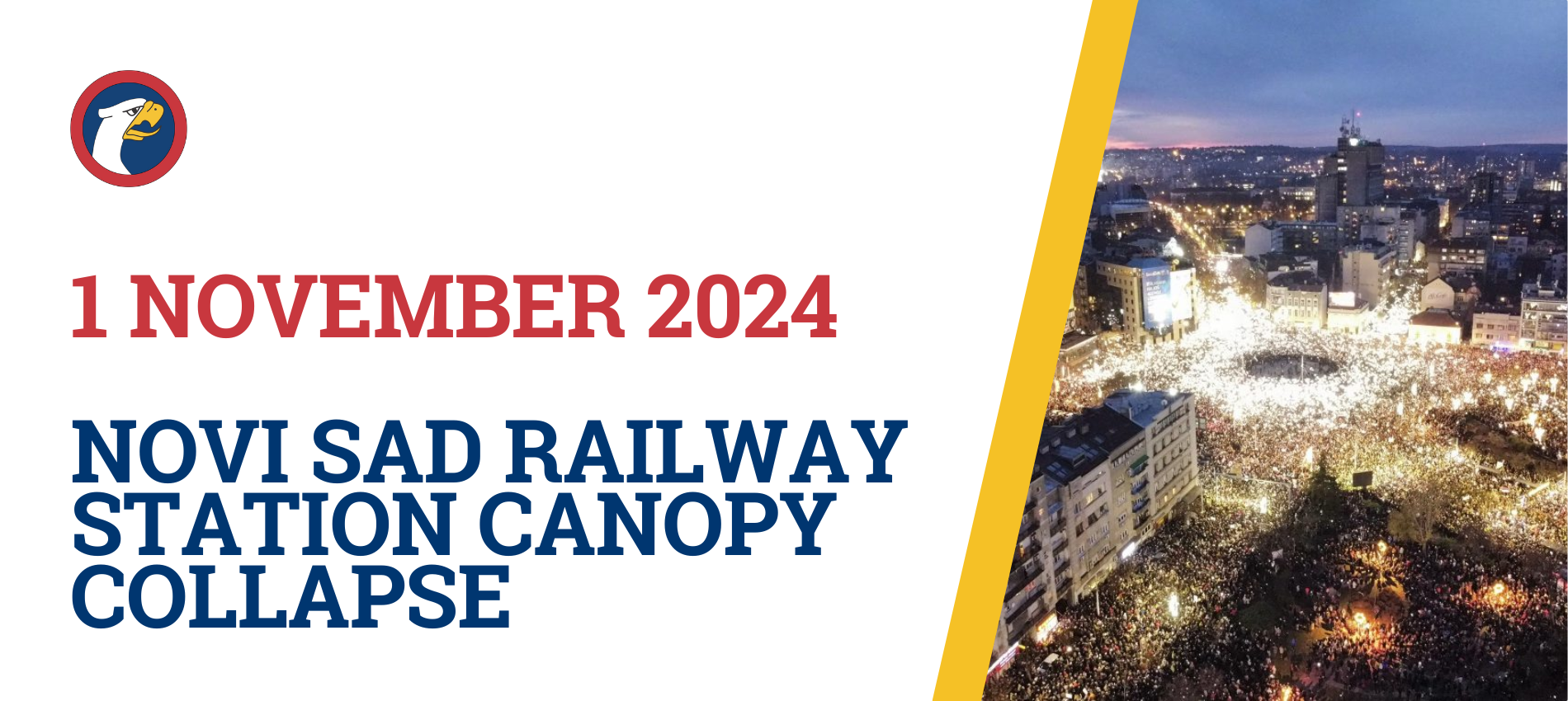
November 2024 – January 2025[1]
On 1 November 2024, a tragic incident occurred in Novi Sad, when a section of the concrete canopy at the city’s main railway station collapsed around noon. This unfortunate event resulted in the loss of 15 lives and left two individuals with severe injuries.[2]
The railway station underwent significant reconstruction from September 2021 to July 2024. This was a part of the construction of a high-speed railway that is envisaged to connect Belgrade and Budapest as a part of the Chinese Belt and Road initiative. The station was opened in July 2024[3], with then Minister of Construction, Transport and Infrastructure Goran Vesić declaring it “fully operational”.
On 22 November 2024, the Higher Public Prosecutor’s Office in Novi Sad announced that four public officials are suspected of the criminal act of causing general danger and nine construction experts of the criminal act of irregular and improper execution of construction works. The charges against all of these persons were confirmed by the Prosecutor’s Office on 30 December 2024. Among the charged officials is Goran Vesić, who resigned as Minister on 4 November. Vesić and most of the suspects were arrested on 21 November. As of December, 10 out of 13 suspects remain in custody; Vesić was released following a court decision.
Serbia remains in a tense political atmosphere in which a part of the public suspects that the ruling party is trying to protect the people who were responsible. This lack of trust persists even after the charges and arrests. Several protests and acts of civil disobedience were organized by opposition parties, primarily in Belgrade and Novi Sad. Since late November, the main development has been the protest of university and high-school students across the country which resulted in blockades of dozens of faculties. Since January, various social groups supported the students and protests in support of their demand have taken place in almost every municipality in Serbia. Many actions of the authorities and the ruling party since the start of the protests have been criticized as repressive and authoritarian, including allegations of use of secret services to intimidate the students.
On 28 January, following an incident in which a student in Novi Sad was seriously hurt by persons connected with the ruling party, Prime Minister Miloš Vučević announced his resignation. As of 10 February, the resigantion has not yet been confirmed by the parliament, meaning that the constitutional deadline of 30 days for the election of the new government has not started yet.
Causes of the tragedy
In the excerpts of the criminal charges published in the media on 26 November, the prosecution claims that the institutions responsible for the maintenance of the railway station failed to notice the corrosion of the metal cords holding the canopy, which was their responsibility. Also, a new layer on concrete which was added during the reconstruction put additional pressure on the cords. Finally, the station was opened while the works were still not complete and without inspection being carried out. Which of these aspects was the main contributor to the collapse remains disputed among the experts.
The reconstruction was commissioned by the owner of the railway station, public company Infrastruktura železnice Srbije and was carried out by a consortium of Chinese companies CRIC&CCCC, which hired local subcontractors. The main subcontractor is a local construction company Starting, which reconstructed the canopy itself. This company has also been hired on other infrastructure projects of political significance for the government in recent years, including the Belgrade Waterfront. Opposition claims that the company enjoys political protection of the Serbian Progressive Party, and none of its employees has been charged or arrested.
Commentators have also interpreted the incident in the wider context of general problems with infrastructure projects in Serbia. These include persistent allegations of corruption, negligence and non-transparency. The contract made with the Serbian institutions was not made public on the request by the Chinese companies. The price of the reconstruction of the station – EUR 16 million – has been described as potentially inflated by several experts; however, no charges for corruption have been pressed so far.
Initial resignations (November 2024)
Members of the government and media close to the ruling party initially denied that any work had been done on the canopy, and then tried to deflect the responsibility to the original constructors of the railway station, which was built in 1964. Due to the mounting pressure of the public, however, Goran Vesić announced his resignation as Minister of Transport on 4 November 2024.
Vesić’s resignation was followed by more than two weeks during which there were neither further resignations nor arrests. This led to a significant rise of political tensions. Finally, on 20 November, Tomislav Momirović, Vesić’s predecessor as Minister of Transport (2020-2022) resigned from his position as the Minister of Trade. The following day, Vesić and other lower ranking public officials – but not Momirović – were arrested.
The resignations of Vesić and Momirović were only the second time since 2012, when Serbian Progressive Party (SNS) came to power, that its Ministers resigned due to public pressure. Vesić’s arrest was also the first arrest of a former SNS government minister. In the previous years, investigative media outlets uncovered a series of potential corruption and even potential criminal scandals involving the members of the government, yet nobody has been investigated.
Initial protests and arrests of protesters (November 2024)
On 5 November, local opposition parties in Novi Sad organized a protest titled “You are guilty!”, demanding the resignations of the Prime Minister of Serbia Miloš Vučević (SNS), who was the mayor of Novi Sad from 2012 to 2022, and the current mayor Milan Đurić (SNS). The protest was attended by around 22.000 citizens, making it one of the largest in the history of Novi Sad. Following a protest walk, a small group of protesters, mostly young men, started vandalizing the City Hall and clashing with the police. Opposition parties subsequently released a press statement, condemning the violence of the “paid hooligans who were organized by the government so that they could paint a peaceful protest of the tens of thousands of citizens as violent”.
On 6 November, Ministry of Interior announced that 14 persons were detained in the context of the protest in Novi Sad. Among the prominent detainees were opposition councilor Miša Bačulov and Goran Ješić, a former official from the ranks the opposition Democratic Party (DS). The grounds for the arrest of all detainees, particularly Ješić, were disputed by their lawyers and parts of the public, which led to the arrests being described as politically motivated. After spending several weeks in custody, all detainees were released by the end of the month, which was interpreted as the result of further protests and public pressure.
A peaceful protest in Belgrade took place on 11 November 2024, gathering around 10,000 people. The following weeks were marked by acts of civil disobedience by oppositions and activist groups, in which hundreds of people participated. Each Friday since 15 November, protesters have been blocking the streets of Serbia for 15 minutes to commemorate the victims and demand justice.
This practice has become a subject of tensions and controversy, as each week it was interrupted at some locations by provocateurs, many of whom were identified as members of the ruling party. These provocations have led to physical assaults which left some of the protesters injured and also triggered the wave of student protests (see below). On 28 November, the opposition posted what it claims to be leaked voice messages of Damir Zobenica, an SNS official, ordering the party members to provoke incidents during the 15-minute street blockades scheduled for 29 November.
On 19, 20 and 21 November, opposition members blocked the entrance into the building of the Higher Prosecutor’s Office in Novi Sad for several hours, demanding the arrests of those responsible for the tragedy and release of protesters. These demands were partially met starting from 21 November. The blockades included scuffles between the opposition and the police, but both sides remained relatively restrained and there were no serious injuries.
Nevertheless, during the weekend of 23-24 November, it was reported that one of the participants of the blockade in Novi Sad, activist Ilija Kostić (74) was arrested and beaten by the police after spraying tear gas at them during the protest. His injuries were reportedly so severe that he had to be operated and had his testicle removed. This case caused additional accusations of police brutality by the opposition and calls for the Minister of Interior Ivica Dačić to resign. Dačić denied that Kostić was injured by the police, but said that the case will be further investigated.
Tensions in the parliament (November – December 2024)
In mid-November, 84 opposition MPs submitted a motion of no confidence in the Prime Minister Miloš Vučević. A requirement for this motion to be put on the agenda is the support of 60 MPs, which was met. However, President of the National Assembly Ana Brnabić (SNS) subsequently refused to put the motion on the agenda, arguing that two MPs from the Freedom and Justice Party (SSP) said their signatures were used without their knowledge. The two MPs defected from the party, citing the misuse of the signatures as one of the examples of disrespect which prompted them to leave, but added that they supported the motion nevertheless.
Opposition MPs said that Brnabić’s refusal to put the motion of no confidence on the agenda represented the violation of the Constitution since more than 60 signatures were collected. They subsequently filed charges against her. During the parliamentary session on Monday, 25 November, with the budget for 2025 was on the agenda, opposition attempted to obstruct the session as a protest against Brnabić’s decision. This led to a physical clash between the ruling and opposition MPs. Nobody was injured, while the session concluded with almost no debate. The ruling parties accused the opposition of inciting violence and wanting to start a civil war.
No further sessions of parliament were held since the end of November, despite the fact that the opposition had submitted another motion for the vote of no confidence in the government, this time without any disputed signatures, as well as a motion to replace Brnabić as the speaker.
The City Assembly of Novi Sad held a vote of confidence in the mayor Milan Đurić (SNS) on 3 December, who retained support of the ruling coalition. The vote was also marked by tense atmosphere and a number of citizens protested in front of the Assembly. Opposition MP Radivoje Jovović (PSG) was detained after this protest and charged with attacking a policeman; he was released after a court decision on 13 December, while the process against him is still ongoing. The City Assembly failed to hold a further session to adopt the budget for 2025. Assembly speaker accused the opposition and the protesting students of attempting to obstruct the session and endanger the safety of councilors, which is why the session was indefinitely postponed.
Student protests (November 2024 – ongoing)
A wave of student protests began in late November, following an attack on the students of the Faculty of Dramatic Arts in Belgrade. On 22 November, these students were physically assaulted by unknown individuals while participating in a 15-minute street blockade, which was not an isolated incident (see above). Opposition and independent media subsequently claimed that at least some of the attackers were members of the ruling party.
As a reaction to the attack, students of the Faculty of Dramatic Arts entered a blockade of the faculty’s work on 25 November, demanding the arrest of the perpetrators. This triggered a wave of student blockades of faculties across Serbia. As of 13 December 2024, all faculties of the country’s two largest universities – University of Belgrade and University of Novi Sad –suspended lectures due to blockades. As of 19 December, 60 faculties were in a blockade. In most of the cases, students have received support from the professors and staff, while only a handful of professors publicly criticized these activities.
This development represents the largest political mobilization of students since the 1996/1997 protests against election fraud committed by the Milošević regime. It is the first time that young people have become decisively involved in the political life since the Serbian Progressive Party came to power in 2012. The students set up ad-hoc bodies, so-called “plenaries” and decided not to have any formal leadership and dozens of them have been addressing the media in the name of their colleagues.
Informal group “Students in a blockade” released a list of demands on 3 December: 1. Publishing of all documentation related to the reconstruction of the Novi Sad railway station; 2. Dropping of charges against the students arrested during the protests; 3. Criminal charges against the persons who attacked the students during the protests; 4. Their resignations if they are public officials; 5. Increase of the public financing of state faculties by 20%.
Initially, the government officials and members of the ruling party rejected the demands. However, on 11 December, President Aleksandar Vučić held a press conference declaring that all demands will be accepted and that the government will start publishing all documentation related to the railway reconstruction on the following day.
The communication that all demands had been met was maintained by SNS members in the coming weeks. Damir Zobenica, SNS official whose alleged voice messages instructing SNS members to provoke the protesters leaked on 28 November (see above), resigned as Vice President of the Assembly of Vojvodina on 13 December. Charges were also brought against several individuals suspected of attacking the students.
Nevertheless, experts soon pointed out that contracts with the construction companies were missing among the documentation released by the government of Serbia, which still prevents the public to trace the money flows within the project. Informal group “Students in a blockade” stressed on 13 December that the demands related to the release of documentation and charges against persons who attacked the protesters were not fully met and that the blockades continue.
Since then, the Government published more documentation on several occasions, each time declaring that all demands had been met, most recently on 27 January. As of 10 February, the students maintain that their demands have not been met. In early February, University of Belgrade set up expert groups to assess the fulfilment of student demands. The groups have not made an assessment yet. Also, an informal group of experts formed an “inquiry commission” on 5 February to examine the documentation and, as stated, determine the responsibility for the collapse of the station.
In addition to the blockades of the faculties, students also started to hold street protests and protests in front of certain state institutions. Up to 100,000 citizens were estimated to had attended the student-organized protest on Slavija square in Belgrade, held on 22 December 2024, making it one of the largest protests in the history of Serbia. Protests were also held during the New Year’s Eve. Several massive protests were also held in January, especially during the 24-hour blockade of the intersection Autokomanda in Belgrade. On 1 February, student-organized blockades of three bridges in Novi Sad were held to mark the three months since the tragedy.
Intimidation against the students (December 2024 – ongoing)
In the last weeks of December, as the students’ blockades entered the second month, there were reports of various intimidation attempts against them. The case that attracted most attention was the calls made to several students to attend an informal conversation with the Security and Intelligence Agency (BIA). Experts pointed out that there was no legal ground for this. In one case, when a student’s father answered the call and arrived to the police station at an agreed time with his lawyer, nobody from BIA showed up. The calls were described as intimidation attempts. Another student received a threatening phone call from a person who introduced himself as a police inspector.
Pro-government media also started to target several prominent students with smear campaigns. Particularly vicious attacks were directed at Mila Pajić, a student from Novi Sad, who was previously prominent as an activist. One of the narratives promoted by the pro-government tabloids has been that students were attempting a Western-backed “coloured revolution” against the Serbian government. Another prominent narrative is that the students are coordinated by the Croatian secret services.
In a highly controversial case, a tabloid Večernje novosti published passports of two students from the Faculty of Organizational Sciences from Belgrade, showing that they have Croatian citizenship, which allegedly proved the involvement of the Croatian state in the protests. The students have the right to citizenship as children of the Serb refugees from Croatia during the 1990s war. The publishing of their personal data was against the law.
Further escalation of the protests (January 2025 – ongoing)
A serious incident occurred on 16 January, when a car hit a student during a regular 15-minute street blockade in Belgrade to commemorate Novi Sad victims. The student, who was standing on a street walk, was seriously hurt and taken to the hospital while the driver was arrested shortly afterwards and charged with attempted murder. The student was released from hospital to house recovery on 20 January.
The case once again contributed to the escalation of tensions, given the fact that this was not the first time that a car drove through a blockade, as these and similar provocations took place regularly in November and December (see above). In a press conference on 1 December 2024, President Aleksandar Vučić justified the citizens driving through the protesters, saying that this did not violate any laws and that the protesters themselves were jumping on the hoods of the car, wanting to provoke incidents. The opposition and protesters accused Vučić of inspiring the incident on 16 January with this statement.
In response to the incident, a new wave of mass protests took place across the country, including the protest in front of the public broadcaster Radio-Television of Serbia on 17 January, which gathered up to 55,000 people. Members of the opposition in Novi Sad “occupied” the City Hall on the same day, before being ejected by the police. Miran Pogačar, opposition councillor in the Novi Sad Assembly, received 90 days of house arrest for the action.
Since 20 January, the protests have been widening to include other social groups, including teachers and lawyers. According to pro-government sources, the school semester, which was supposed to begin on 20 January, did not start properly in almost 20% of schools across the country due to the teachers suspending classes in support to the students. The Lawyers’ Chamber of Serbia voted to enter a 7-day strike in support to the protests, which was speedily overturned by the Higher Court in Belgrade; the ruling remains disputed. The Lawyers’ Chamber of Serbia voted again in February to enter a 30-day strike. Opposition and public figures supporting the protests have repeatedly called for a general strike until the student requests are met.
In late January, hooligan groups believed to be associated with the ruling party intensified their activities, including a large-scale spraying of vulgar graffiti against the protests in Belgrade and other cities. Around the same time, the ruling party started organizing counter-rallies and gatherings, mostly focused on support to President Aleksandar Vučić. These events have so far been organized outside of big cities.
Resignation of the Prime Minister (January 2025)
On the night of 27-28 January, multiple students were injured in Novi Sad while putting on posters calling for a protest on 1 February. They were attacked by men with baseball bats, who emerged from the city headquarters of the ruling Serbian Progressive Party (SNS). One student was seriously hurt and was admitted to a hospital with a broken jaw.
The attackers were arrested, while their exact connection with SNS has not been clarified. Several hours after the attack, Prime Minister Miloš Vučević announced that he would resign after leading the government for nine months. Vučević is expected to remain President of the Serbian Progressive Party, a position he inherited in May 2023 from Aleksandar Vučić (who is widely seen as still being the de facto leader of the party). Milan Đurić, Vučević’s successor as the mayor of Novi Sad, also announced his resignation.
As of 10 February 2025, Vučević is still Prime Minister because the parliament has not met to confirm his resgination. No session of parliament has been held since the one in November, during which ruling and opposition MPs clashed (see above). Once the parliament confirms Vučević’s resignation, a 30-day deadline would start for it to elect a new government, or a snap election would take place. Opposition parties stated they would boycott a potential election if electoral conditions do not improve.
[1] Updated as of 10 Febrary 2025
[2] 14 persons died on the spot, while the 15th died two weeks later in the hospital; one person was a citizen of North Macedonia.
[3] An earlier opening ceremony was held in March 2022, when the station was inaugurated by President Aleksandar Vučić and Prime Minister Viktor Orbán during the election campaigns in both Serbia and Hungary