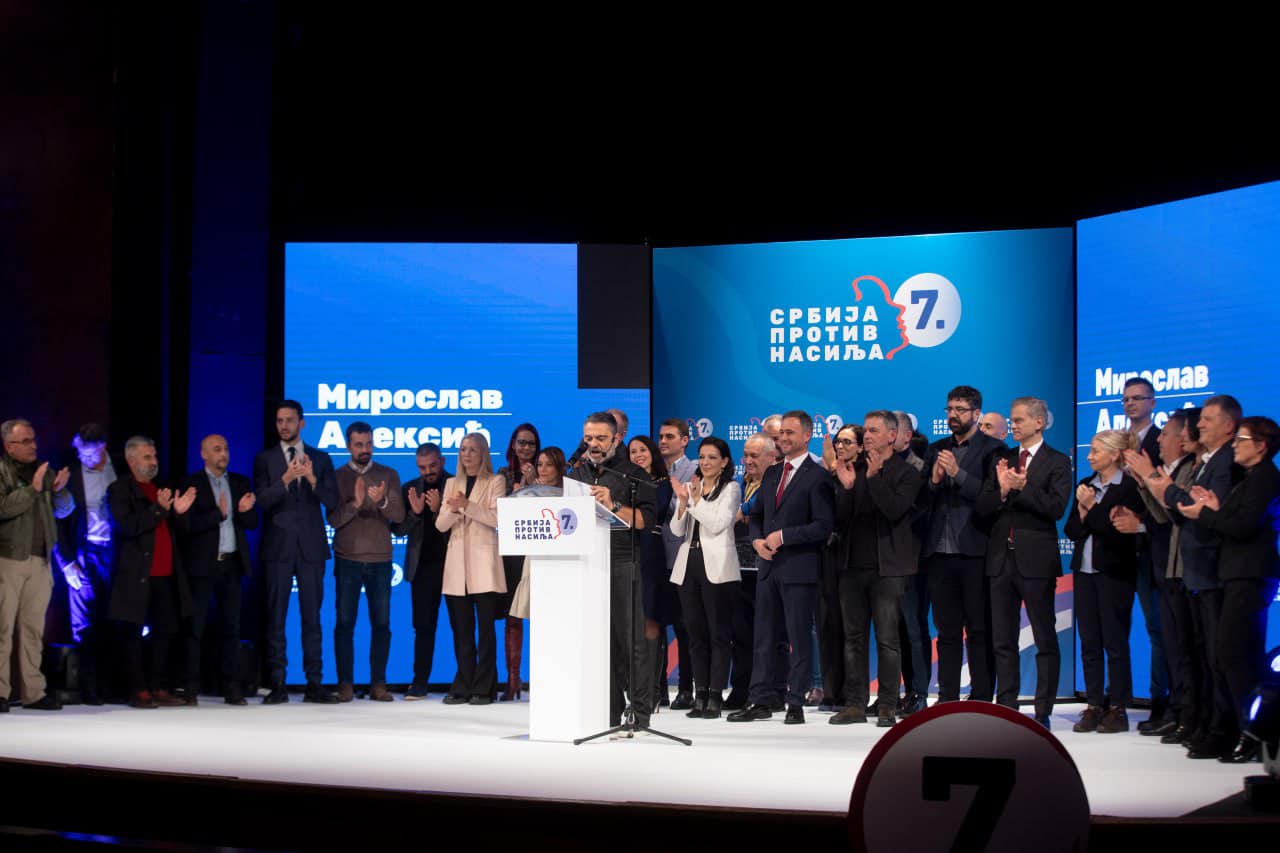
Serbia Against Violence members in the city of Niš, 17 November
Photo: Facebook / Zeleno-levi front
According to the polls, the electoral list Serbia Against Violence is the leading opposition coalition in the upcoming elections. Pro-EU political parties that organised the months-long mass protests “Serbia Against Violence” earlier this year joined forces ahead of elections on 17 December.
It is a new format of cooperation within the Serbian opposition, after several unsuccessful attempts to unify since 2018. However, now almost all relevant pro-EU options are included, for the first time since 2012, when Serbian Progressive Party (SNS) came to power. The polls suggest that Serbia Against Violence could be the first opposition coalition to win more than 20% since then.
The fact that most of the political parties that make up the coalition were created after 2012, during the rule of the SNS, reflects the instability of the opposition scene in those years.
2012-2016: The divisions within the DS
The only party in the coalition that existed before 2012 is the Democratic Party (DS), which was once led by the late Prime Minister Zoran Đinđić and was in power from 2001 to 2004 and again from 2007 to 2012.
In the 2012 elections, Democratic Party, which was then led by President of Serbia Boris Tadić, finished second by winning 22% of the votes and went into opposition after Tadić lost the subsequent presidential election runoff. The leader of DS became Dragan Đilas, then mayor of Belgrade.

In 2013, a faction separated from the Democratic Party and formed Together for Serbia party – today it is called Together, and it is profiled as a green regionalist party. The party is now co-led by Nebojša Zelenović, who was the mayor of the city of Šabac until 2020, as one of the last remaining non-SNS mayors at the time.
A year later, the largest division of the Democratic Party occurred, which permanently reduced its poll numbers. Former president of Serbia and DS Boris Tadić left the party in January 2014 and founded New Democratic Party. In the subsequent election held in March 2014, Democratic Party and New Democratic Party won approximately the same vote share – 6% and were the only two opposition lists to cross the threshold. SNS, meanwhile, scored its first dominant victory, winning 48% of the vote. After this result, Đilas temporarily retired from politics. Tadić’s party was renamed to Social Democratic Party (SDS).

The next extraordinary parliamentary election was held in April 2016 and brought similar results for pro-EU parties, as Democratic Party retained 6% of the vote. Tadić’s SDS entered the parliament in a coalition with liberal parties. The then new technocratic, liberal-leaning party Enough is Enough (DJB), led by the former Minister of the Economy Saša Radulović, also won seats.
The period after 2016 was marked by weakening of all of these parties. By 2020, none of them were able to compete for the parliamentary threshold on their own. The period also saw the proliferation of new parties.

2016-2020: Founding of the new parties
Shortly after the presidential elections in 2017, two opposition candidates, former Ombudsman Saša Janković, who won 16% of the votes, and former Minister of Foreign Affairs Vuk Jeremić, who won 5.5%, founded new political parties. Janković’s Free Citizens Movement (PSG) was formed as a liberal, strongly pro-EU political party, while Jeremić’s People’s Party (NS) was positioned on the center-right.
During 2018, attempts were made to form a broader opposition coalition. In 2018, after the return of Dragan Đilas from political retirement, the first major format of opposition cooperation was established – the Alliance for Serbia. It was made up of some parties that today are part of the Serbia Against Violence coalition, as well as some right-wing political parties. This Alliance coordinated the “One of the Five Million” mass protests from the end of 2018 and in the first half of 2019.
In 2019, a new opposition political party of Dragan Đilas – Freedom and Justice Party (SSP) – was officially formed, as a social democratic party positioned to attract former voters of DS. Due to poor election conditions, a joint decision was made within the Alliance for Serbia to boycott the regular parliamentary and local elections in Serbia in June 2020. Free Citizens Movement ran independently but failed to pass a reduced threshold of 3%. After the boycott of the 2020 elections which left the parliament without any viable opposition, the Alliance for Serbia ceased to exist.

2020-2023: New green parties and two splits of the People’s Party
In the period before the extraordinary parliamentary elections announced for April 2022 as a consequence of the “oppositionless” parliament, there was a rise of local ecological and green movements and parties, which gained national recognition in the wave of mass protests across Serbia due to environmental degradation. These were the Ecological Uprising, headed by Aleksandar Jovanović Ćuta, “Do not let Belgrade d(r)own” and Nebojša Zelenović’s Together, which formed the green electoral coalition “Moramo” (“We Must”), winning 4.8% of the votes in the 2022 elections. “Do not let Belgrade d(r)own” was later officially registered as the Green-Left Front party (ZLF).
On the other hand, former members of the Alliance for Serbia – Freedom and Justice Party, People’s Party and Democratic Party, joined by the Free Citizens Movement, won 14% of the votes within the coalition UzPS (“United for the Victory of Serbia”) and became the second strongest political coalition in Serbia. SNS, however, remained by far the strongest party in the parliament.

Together with the parliamentary election, the presidential election was also held in 2022, and opposition candidate Zdravko Ponoš, former Chief of Staff of the Serbian Army, won 18% of the votes. Ponoš, who until the 2022 elections was a prominent member of Vuk Jeremić’s People’s Party, subsequently formed his own Serbia Centre (SRCE) party.
Before the December 2023 parliamentary election, there were new divisions and regroupings within the opposition parties. The coalition United for the Victory of Serbia fell apart, and the People’s Party split. Deputy President of the party Miroslav Aleksić left and formed a new centre-right party – People’s Movement of Serbia (NPS), which retained a pro-EU orientation. Within the coalition Serbia Against Violence, Aleksić is one of the co-leaders of the electoral list.
Serbia Against Violence list now consists of Democratic Party and all pro-EU parties formed since 2012, with the exception of Boris Tadić’s SDS. Tadić is running in a coalition with “Enough is Enough” (DJB), which has become Eurosceptic in the meantime. Meanwhile, People’s Party is running on its own. The crossing of the 3% threshold would be considered a success for these two lists.