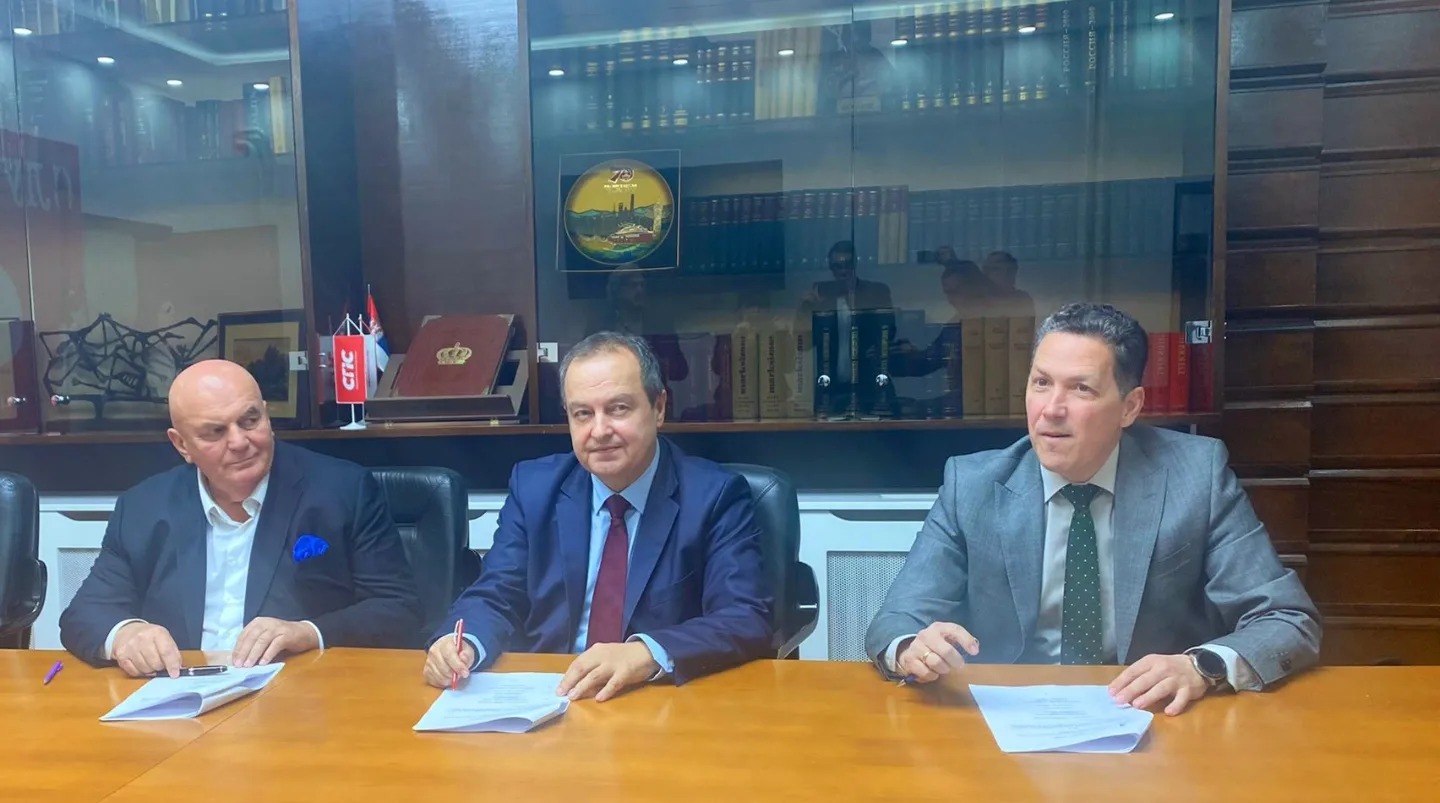
Members of SNS Presidency Ana Brnabić, Aleksandar Šapić and Vladimir Orlić at the press conference announcing new Belgeade election
Photo: FoNet
BELGRADE – The Presidency of the Serbian Progressive Party (SNS) decided today not to form a majority in Belgrade, but to go for a new local election in the capital, announced the party’s mayoral candidate Aleksandar Šapić. Possible legal dates for the election are between the second half of April and the beginning of June, and the exact date is yet to be determined.
Leading up to today’s decision, SNS claimed it had a necessary majority of 56 seats in the City Assembly, together with the longtime junior partner Socialist Party of Serbia (SPS) and two defectors from the list “WE – The Voice of the People”.
Nevertheless, on 18 February, the President of Serbia and, until recently, president of SNS, Aleksandar Vučić said he did not consider such a majority as legitimate, given the fact that it lacked support from Branimir Nestorović, the most prominent candidate of the list “WE – The Voice of the People”.
Since then, SNS has been allegedly negotiating with Nestorović to support the majority in Belgrade. This has not happened, and the party formally decided to go for a new election on Saturday, given the fact that no other list was able to form a majority.
The election in Belgrade held on 17 December returned a hung local parliament. The previous ruling coalition, SNS-SPS, won 54 seats, while the opposition “Serbia against Violence” and NADA coalitions won 50 seats. The remaining 6 seats were won by the populist list “WE – The Voice from the People”, which soon split into factions.
SNS has formed local majorities with defectors in various parts of Serbia in the past, making this decision stand out in that regard.
“We believe that we should raise the ladder of legitimacy and credibility and show that politics is not mathematics and that we are ready to take a decision which is costly for us in the interest of all citizens”, said Aleksandar Šapić at the press conference following the session of SNS presidency.
What preceded the decision?
Immediately after the snap parliamentary and partial local elections on 17 December, the opposition accused the ruling parties of fraud, especially in Belgrade. The following weeks were marked by protests and hunger strikes by several opposition MPs.
In February, the European Parliament adopted a resolution in which it expressed its alarm at “reports of the widespread and systematic scale of fraud that compromised the integrity of the elections in Serbia”.
In its final report on Serbian elections, Office for Democratic Institutions and Human Rights (ODIHR) assessed that the elections, “though technically well-administered and offering voters a choice of political alternatives, were dominated by the decisive involvement of the President, which, together with the ruling party’s systemic advantages, created unjust conditions”.
On 1 March, the Embassies of France, Germany, Italy, the United Kingdom, and the United States called Serbian government to fully implement all ODIHR recommendations, with “meaningful progress” ahead of the Spring local elections.
SNS to form an even wider coalition?
In his remarks at the press conference, Aleksandar Šapić hinted at SNS strategy in the elections. He said that SNS might run in the election in a wider coalition than in December.
In recent weeks, Aleksandar Vučić revived his proposal of a “Movement for the People and the State”, which would include SNS and its partners and would presumably be led by Vučić. Some right-wing parties which were previously in opposition, such as “Zavetnici”, expressed readiness to join such a movement.
In the press conference, Šapić stressed that the vote would be of national importance.
“This election is much larger than usual local elections, they are about values, they are about the survival of our entire society because we have here two approaches to everything… It is not the same if the Serbian capital is led by the government that is ready to defend Serbian interests or the one ready to ‘solve’ all these issues in a second – Kosovo and Metohija, proclaiming Serbian people genocidal, closing ourselves to the east, first and foremost to the Russian Federation”, Šapić said.