
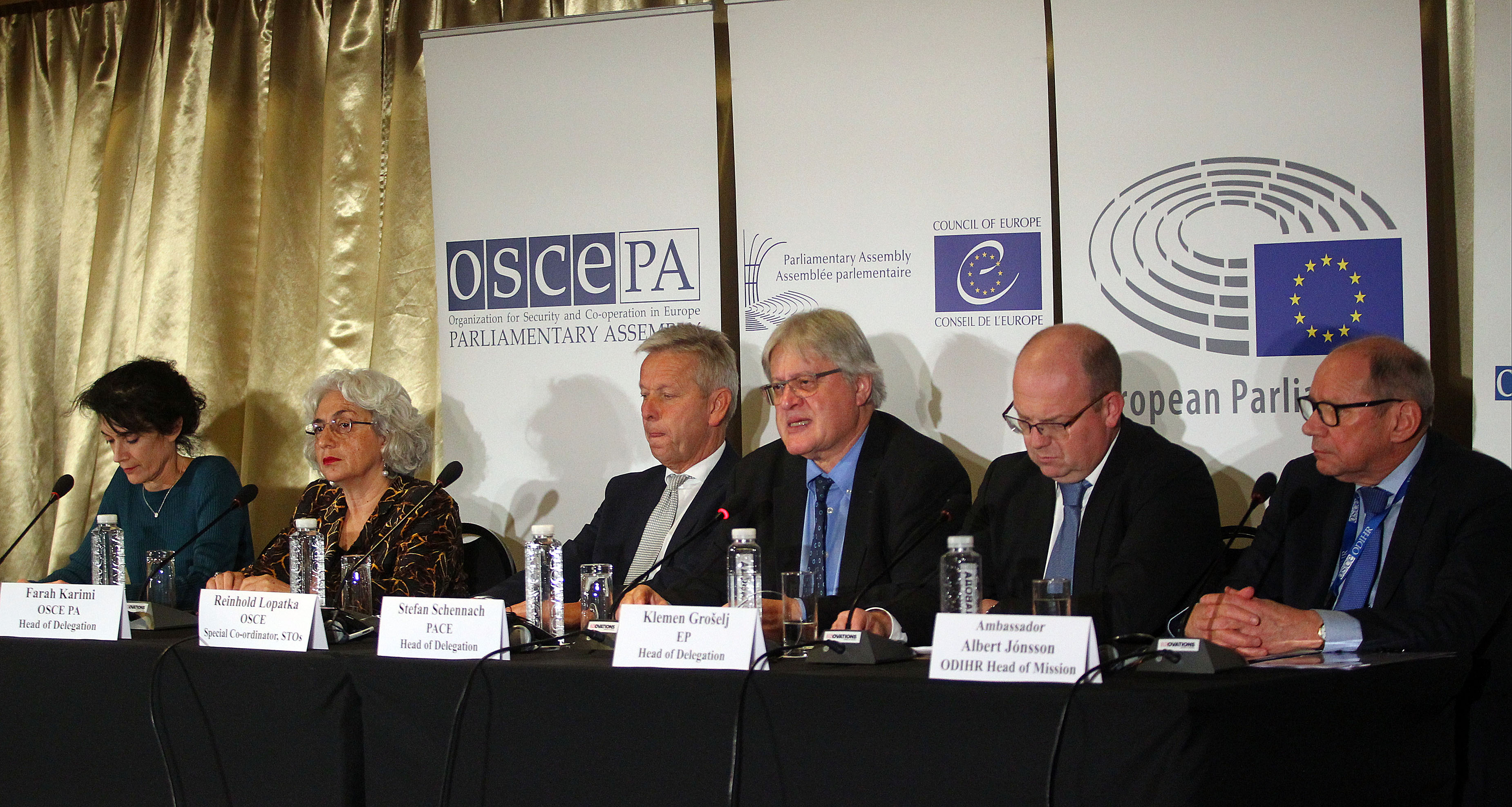
Members of the International Election Observation Mission in Belgrade on 18 December
Photo: FoNet
On Monday, the international observation mission headed by the Organisation for Security and Cooperation in Europe released preliminary conclusions of Serbian elections held on 17 December. While noting that elections were technically well-administered and that the election day was smooth, they also noted a series of irregularities.
According to the conclusions, the 17 December early parliamentary elections, though technically well-administered and offering voters a choice of political alternatives, were dominated by the decisive involvement of the President which together with the ruling party’s systemic advantages created unjust conditions.
“The frequency of early elections has further eroded public confidence in the functioning of democratic institutions and together with the lack of political will left needed reforms unaddressed”, the preliminary conclusions read.
Pressure on voters, misuse of public resources and offices
Fundamental freedoms were generally respected in the campaign, but it was marred by harsh rhetoric, bias in the media, pressure on public sector employees and misuse of public resources, observers assessed.
Commenting on the recent legal changes in line with ODIHR recommendations, their conclusions state that, despite amendments that addressed a number of previous recommendations, several key issues remain outstanding, including those related to ensuring a level playing field, measures to prevent misuse of public office and state resources, separation between the official functions and campaign activities, and effective mechanisms to prevent intimidation and pressure on voters, including vote buying.
The mission assessed that the lack of public intervention by the Agency for the Prevention of Corruption (APC) regarding misuse of public offices reduced the dissuasive effect of its sanctions.
Claims of voter migration diminished trust in Voter Register
When it comes to the Unified Voting Register, “allegations that numerous persons deceased, including abroad, remained in the register, along with claims of voter migration in connection with local elections, diminished trust in its accuracy”, observers assessed.
Their report states that the Republic Electoral Commission published voter registration data disaggregated per municipality and polling station, providing stakeholders with the opportunity for additional scrutiny.
However, the longstanding ODIHR and Venice Commission recommendation to conduct a full audit of the UVR had not been implemented, which the authorities attributed to legal restrictions on personal data privacy, the observers added.
The work of the Republic Electoral Commission benefited from improved transparency, observers concluded, adding that numerous stakeholders acknowledged the improved communication and transparency of the Republic Electoral Commission.
On the other hand, the oversight bodies for campaign and electronic media remained largely ineffective in deterring violations during the election period.
Strong influence of government on most media outlets
In the part of the conclusions focusing on the media, observers noted that the diversity of views is reduced by significant polarization and a strong influence of the government on most outlets.
“While media covered all electoral contestants in line with the law, most national broadcasters lacked genuine analytical reporting, detracting from the voters’ ability to make an informed choice”, the report.
The opposition highlighted their persistent lack of access to broadcasters in presenting their views prior to the elections.
“At the same time, some private broadcasters noted that opposition politicians regularly decline to participate in their programmes, citing bias and potential reputational harm”, the findings read.
It is added that, despite recent legislative changes extending the ban on coverage by broadcasters of public officials participating in public infrastructure inauguration events, the extensive promotion of governmental infrastructure projects during the campaign period by public officials who were not candidates tilted the level playing field.
“While all monitored national channels covered campaign activities of the election contestants in line with the law, the ruling parties and positive coverage of the President dominated the media”, the conclusions read.
The observers added that the absence of genuine analytical reporting on most monitored media impacted voters’ opportunity to make an informed choice and that the oversight body Regulatory Authority for Electronic Media (REM) maintained a notably passive approach to regulating media conduct during the campaign.
Election day smooth, but marred with instances of violence and procedural irregularities
Election day was smooth but marred by isolated instances of violence, procedural irregularities and frequent allegations of organizing and busing of voters to support the ruling party in local elections.
There were multiple allegations of voters living abroad being organized and bused by the ruling party for to cast their ballots for local elections in Belgrade, the report adds.
The International Election Observation Mission positively assessed the voting in 93 per cent of the 1,220 polling stations observed. Negative assessments were primarily attributed to overcrowding and inadequate measures to ensure secrecy of the vote, at odds with long-standing ODIHR and Venice Commission recommendations.
Serious irregularities observed by the observation mission included 9 cases of vote buying and 5 cases of ballot box stuffing.
The report mentions the case of the demolition of the vehicle of CRTA observers in Odžaci, and assaults on polling board members and an activist.


