
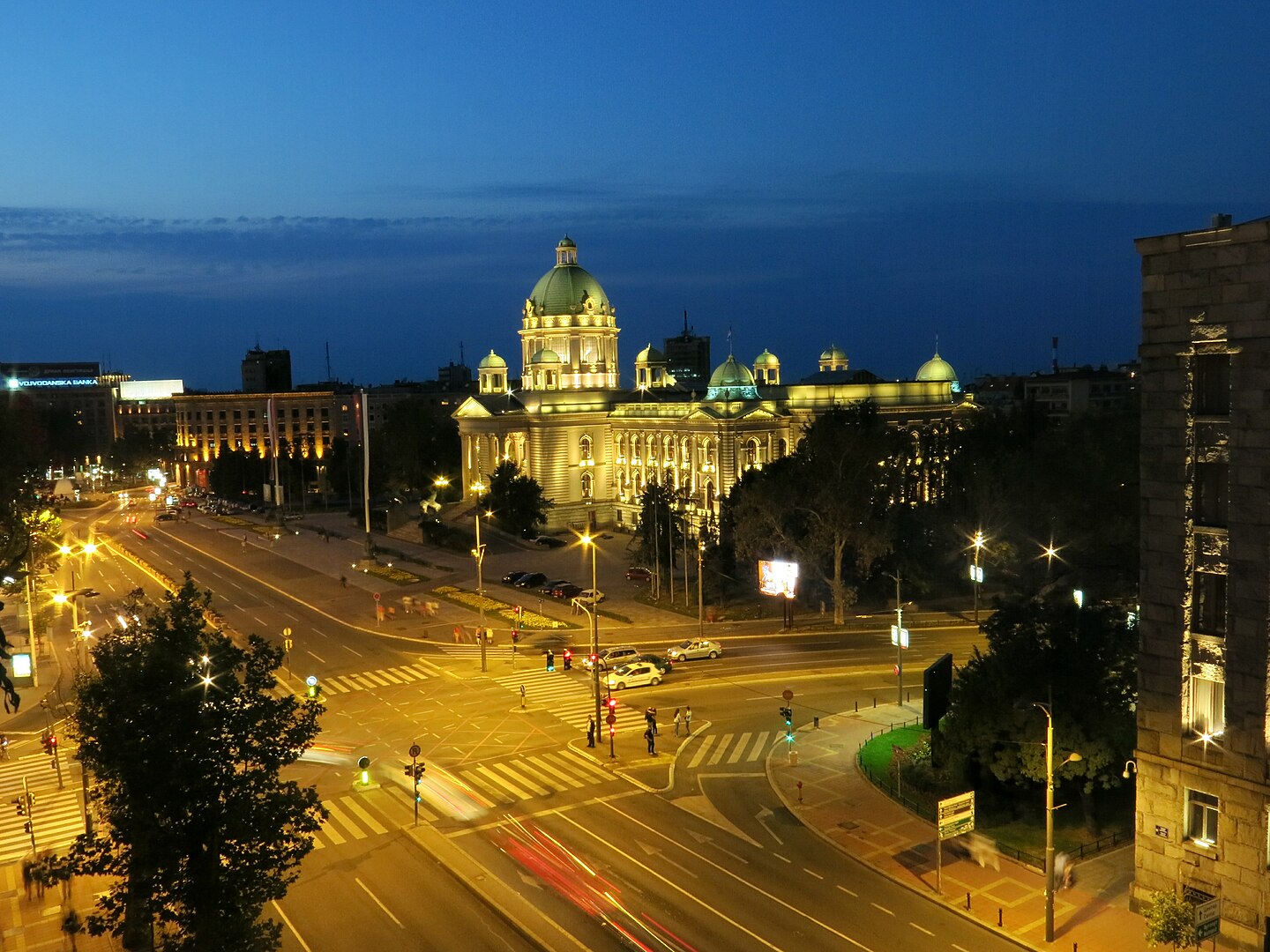
National Assembly of Serbia
Photo: Wikimedia Commons
Which elections are taking place?
- Early parliamentary election for 250 MPs in the National Assembly of Serbia
- Early provincial election for 120 members of the Provincial Assembly of Vojvodina
- Early local elections in 66 (out of 171) cities and municipalities, including the capital of Belgrade
Why are so many early elections taking place?
It is unclear. Various interpretations have been offered by commentators, including those related to the rising costs of living and anti-violence protests in May. They are based on the assumption that the ruling SNS wants to pre-empt a decline in support.
There have also been interpretations related to the strategic delaying of Serbia’s obligations in the Belgrade-Pristina Dialogue, especially after the Banjska attack on 24 September.
The decision to call early provincial and local elections ahead of their regular schedule in June 2024 has also been interpreted in terms of strategic advantages of the ruling party. The election are mostly held in areas where SNS is expected to perform strongly, ahead of more vulnerable areas in June, which could create a positive momentum for the party.
The rule of Serbian Progressive Party (SNS) since 2012 has been marked by strategic early elections. This is the fourth such parliamentary election in 11 years.
Electoral system
All 250 MPs are elected through a closed-list proportional system. The entire territory of Serbia is a single constituency. The final number of voters for the 2023 election is 6,500,666.
In order to qualify for the distribution of mandates, which is based on the D’Hondt method, a list needs to win at least 3% of the vote.
This electoral threshold does not apply to the lists submitted by national minority parties. The number of votes received by these parties is also increased by 35% before the distribution of seats if they win less than 3% of the votes.
Electoral systems for the Vojvodina Provincial Assembly and local city and municipal assemblies are the same, the only difference being the number of seats.
There are no direct elections for mayors. Citizens vote for the local parliaments, which then elect mayors.
What are the results of the previous elections?

In the election held on 3 April 2022, the coalition around the ruling SNS won 120 out of 250 seats, losing the overall majority of 126 for the first time since 2014. Nevertheless, with its coalition partners, Socialist Party of Serbia (31 seats) and several national minority parties, it once again managed to form a stable majority.
Pro-EU opposition entered the parliament in 2022 on two lists: United for the Victory of Serbia (UzPS) with 38 seats and “We Must” (“Moramo”) with 13 seats.
Right-wing opposition entered the parliament on three lists: NADA coalition (15 seats), coalition led by “Dveri” (10 seats) and “Zavetnici” (also 10 seats). National minority lists won the remaining 13 seats.
The capital of Belgrade also held elections on 3 April 2022, and the results were much closer. SNS list won 38% of the votes, while the two pro-EU lists (which are now running together) jointly won 33%.
SNS and SPS managed to win the minimal majority in the city parliament in 2022 (56 out of 110 seats), which was later increased by several defections of local councillors elected on the right-wing lists.

In Vojvodina, the 2020 provincial election was boycotted by a large part of the opposition (together with the parliamentary and the local ones). This enabled the ruling SNS-SPS-VMSZ (Hungarian minority) coalition to win 100 out of 120 seats, while the rest was allocated to the regionalist LSV and right-wing parties.

Who are the candidates this time?
The coalitions around the ruling Serbian Progressive Party (SNS) and the Socialist Party of Serbia (SPS) are once again running in the parliamentary election.
Two pro-EU opposition lists from last election, meanwhile, have joined forces in the 9-party “Serbia Against Violence” coalition, named after the massive anti-violence protests that broke out following mass shootings in May.
Conservative NADA coalition is running in the same form it did last year, while “Dveri” and “Zavetnici” joined forces in a right-wing nationalist “National Rally” coalition.
Six other lists submitted their nomination, including the one headed by controversial doctor Branimir Nestorović, who was above 3% threshold in a recent polls. Additionally, seven minority lists are running as well.
The complete list of candidates for the parliamentary election (list of names are shortened; more details here):
- Aleksandar Vučić – Serbia Must Not Stop
- Ivica Dačić – Prime Minister of Serbia
- Vojislav Šešelj – Serbian Radical Party
- Milica Đurđević Stamenkovski – Boško Obradović – National Rally
- Dr. Miloš Jovanović – Hope for Serbia – Serbian Coalition NADA – Vojislav Mihailović
- Alliance of Vojvodina Hungarians – For our President, for our community, for our future!
- Serbia Against Violence – Miroslav Miki Aleksić – Marinika Tepić
- Party of Justice of Reconciliation – Democratic Alliance of Croats in Vojvodina
- SDA Sandžak – Dr. Sulejman Ugljanin
- Together for Future and Development – Coalition for Peace and Tolerance
- People’s Party – Safe Choice. Serious People
- Saša Radulović – Boris Tadić – Good Morning Serbia
- “Political Struggle of Albanians Continues – Shaip Kamberi”
- We – The Voice From the People, Professor Dr. Branimir Nestorović
- Serbia in the West – Experts Should Have a Say
- Russian Party – Slobodan Nikolić
- Čedomir Jovanović – It Must Be Done Differently
- Albanian Democratic Alternative – United Valley
In Vojvodina, 13 lists were submitted for provincial election. The first 12 lists are composed of the same parties and coalitions that also submitted their lists for the parliamentary election. The 13th list was submitted by a coalition led by the League of Social Democrats of Vojvodina, a regionalist party.
In Belgrade, 14 lists were submitted. Five major national coalitions – SNS, SPS, Serbia Against Violence, NADA and National Rally – submitted their lists for Belgrade as well. Seven other lists in Belgrade were also submitted by parties and coalitions running on the national level, leaving two minor lists running only in Belgrade.
Which polls were published during the campaign?
Polls in Serbia are generally scarce, but this campaign was especially notable for a low number of polls.
- Pollster NSPM released a poll on 15 November
- The same pollster released another poll on 12 December
- Ipsos released a poll on the final day of the campaign, on 14 December
- A previously unknown pollster OfiD, whose credibility cannot be determined, also released two polls on 14 December – for the parliamentary and the Belgrade elections
How democratic was the campaign?
Candidates were mostly able to submit their nominations and campaign freely. However, multiple major issues which marked recent campaigns in Serbia were present again.
The fact that the President of Serbia, Aleksandar Vučić, is the most visible figure in the campaign, even though he is not running for any position in these elections, has been regarded as problematic. Vučić stepped down as President of the ruling SNS in May, but is still acting as a de facto leader of the party.

Vučić at the celebration of the 15-year anniversary of SNS, October 2023
Photo: X / @sns_srbija
According to the finding of the Crta monitoring mission, during the first 36 days of the election campaign, the media landscape in Serbia has maintained existing inequalities of the representation of political actors on TV channels with national coverage.
Various forms of pressure on voters and allegations of vote buying were among the most frequently recorded electoral irregularities.
The election campaign has also been marked by widespread abuse of public resources and the campaign of public officials. Transparency Serbia found that the number of promotional activities of public officials increased by 330% in the first 43 days of the campaign compared to the same period (November-December) last year, when there was no election campaign.
You can read more about the level of democracy in the campaign here.
Election day and the subsequent deadlines
The polling stations are open from 7 to 20 on election day. All citizens who arrive at a polling station before 20 have the right to vote.
Republic Electoral Commission (RIK) determines the preliminary results of the election within 24 hours from the closing of the polling stations.
Republic Electoral Commission has a deadline of three days to call repeat voting from the time of annulment of the vote by a local electoral commission, so that the vote is conducted within ten days following the adoption of the RIK decision.
Within 96 hours following the closing of polling stations, the local electoral commission shall issue a report on the voting results and send it to RIK which will compile and publish a general report on election results within 96 hours.
The first session of the new National Assembly is called within 30 days from the publishing of the report on election results.
The new National Assembly has a constitutional deadline of 90 days to elect a new government.

